
The Five Criteria Every Wellness and Longevity Founder Should Use to Choose Their Business Home in Asia
Most founders spend more time choosing their brand colours than choosing where to operate. That is a costly mistake. Here is the framework that fixes it.
The Decision Most Founders Get Wrong
Founders in the longevity and wellness space usually do everything right. They build a compelling service. They define a clear philosophy. They hire thoughtfully and invest in their brand.
Then they choose a location based on rent.
Twelve months later, they are spending far more on marketing than planned, acquiring clients more expensively than projected, and wondering why growth feels so hard despite doing most things right.
Location was the decision they made last. It should have been one of the first.
In wellness, where you operate shapes what your brand becomes. The environment communicates your standards before a single client walks in. The brands next to you either validate your positioning or quietly undermine it. The community around you either generates referrals or generates silence.
Here are the five criteria that actually matter.

High foot traffic in the wrong area is worse than lower traffic in the right one.
1. Catchment Quality Over Footfall Volume
High foot traffic in the wrong area is worse than lower traffic in the right one. A flood of price-sensitive consumers damages a premium wellness brand. A smaller flow of health-literate, high-spending professionals builds one.
The right catchment for a longevity or wellness business has three layers. Health-conscious professionals who already invest in preventive care. Affluent consumers spending on long-term health, not just reactive treatment. And international visitors from markets where longevity medicine is well established.
Singapore's per-capita wellness spend sits at USD 2,898, over four times the global average and seven times the Asia-Pacific average. But within Singapore, catchment quality varies significantly by district. A location in the Civic District draws from CBD office workers, luxury hotel guests, cultural visitors, and residents from some of the city's most affluent neighbourhoods. That is a meaningfully different audience from a suburban shopping mall, even with lower footfall numbers.
The question to ask of any location is not how many people walk past. It is who they are, what they already spend on health, and whether they refer others like themselves.
2. Regulatory Compatibility Before You Sign Anything
Singapore's regulatory environment for wellness and health businesses is clear, structured, and manageable. But it rewards founders who do their homework early.
The landscape divides into three broad tiers. Pure fitness and movement studios without therapeutic claims operate as standard service companies under ACRA registration. Allied health services, including physiotherapy, chiropractic, and TCM, require professional licensing beyond standard incorporation. Medical clinics and longevity medicine practices require MOH licensing, and specialist clinics handling controlled substances need additional HSA approvals.
URA governs land use and zoning. Private medical clinics are permitted in commercial buildings on commercially zoned land, but this needs confirming for every specific site. Add BCA accessibility standards, NEA compliance, and MOH facility approval, and the regulatory picture has several moving parts.
The founders who move fastest are those who choose locations where the groundwork is already done. Joining a purpose-built health environment with existing regulatory clearance can remove months from the setup timeline.
3. Brand Adjacency Is a Growth Strategy
The brands operating around you are always sending a signal on your behalf. The question is whether that signal helps or hurts.
A longevity clinic next to fast-food concepts and discount retail sends one message. The same clinic within a curated ecosystem of preventive health, movement, nutrition, and recovery brands sends a completely different one. The environment is doing brand work around the clock, independent of anything you publish online.
Adjacency also drives referrals. When a physician, a movement specialist, and a nutritionist operate in proximity, the referral loop between them becomes natural and frictionless. When those same practitioners are scattered across the city, the loop rarely closes. Clients fall through the gaps. Revenue that could have flowed across the ecosystem disappears instead.
The question to ask of any prospective location: do the brands nearby make mine more credible? Do they attract clients I want? And do they create referral pathways, or just competition?
4. Ecosystem Access Versus Isolated Operation
Adjacency is about who is near you. Ecosystem access is about what the whole environment makes possible. They are related but not the same.
A purpose-built wellness ecosystem provides shared infrastructure that no single practitioner could justify building alone. Collective brand identity. Shared marketing reach. Cross-referral pathways. Events that draw a qualified audience to the ecosystem, not just to one practice.
Founders who join an established ecosystem inherit that momentum from day one. Founders who operate in isolation have to build all of it themselves, which means spending time and money on brand awareness that could have gone into clinical quality and team development.
Practitioners operating within co-location models consistently outperform isolated practices on referral volume and client retention. A client referred by a trusted practitioner next door arrives with higher confidence and stays longer than one acquired through a paid ad.
The distinction to make when evaluating any location: am I choosing a space, or joining an ecosystem?
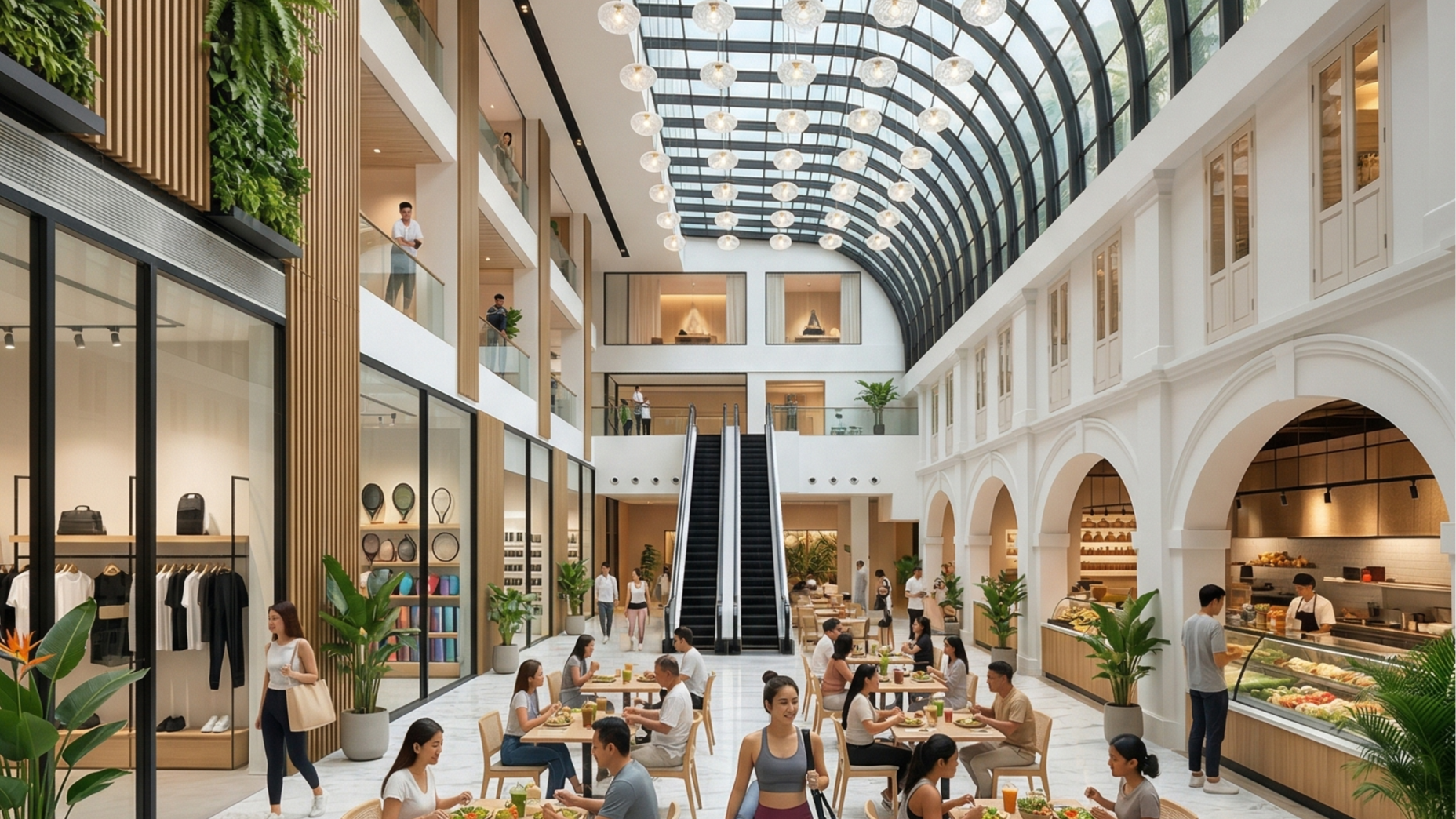
A commercial space gives you four walls and a postcode. A platform gives you a brand context, a community, a shared narrative, and a positioning advantage
5. Are You Renting Space or Entering a Platform?
The most important question a wellness founder can ask about any location is this: does this place give my brand a lift on day one, or do I build that entirely myself?
A commercial space gives you four walls and a postcode. A platform gives you a brand context, a community, a shared narrative, and a positioning advantage that works independently of your own marketing spend.
Where a business chooses to operate acts as a physical statement of its values. The best platforms understand this and use their environments as active brand assets. They generate press. They attract aligned founders. They create content and events that build collective authority. They make the whole greater than the sum of its parts.
Entering a platform early matters most. Founding members shape the community's character, establish referral relationships before the ecosystem reaches capacity, and carry the positioning advantage of being associated with something category-defining from the start.
Why Singapore Answers All Five Criteria
Apply this framework to the major markets in Asia, and Singapore sits at the top on almost every dimension.
The country's demographics make the case clearly. Over 20 per cent of Singapore's citizen population is now aged 65 and above, a figure set to reach one in four by 2030. This is a population actively seeking preventive health, longevity medicine, and integrated wellness, not as a luxury, but as a practical response to ageing.
The spend is there. Per-capita wellness expenditure of USD 2,898 puts Singapore far ahead of the regional average. Consumers here are already allocating meaningful budgets to their health.
The policy environment actively works in a wellness founder's favour. Healthier SG is one of the most ambitious national preventive health programmes in Asia, subsidising screenings and incentivising healthy behaviour at scale. The government is building the consumer mindset that wellness founders need.
The longevity sector here has real density. Over 100 longevity companies and 80 active investors were operating in Singapore as of 2019. That number has grown considerably since.
And the Global Wellness Institute has designated Singapore as the world's first Blue Zone 2.0, a country that has engineered longevity outcomes through deliberate policy. Founding your longevity business here places it within that story by association.
Longevity World Singapore: Built for All Five
Longevity World Singapore was designed as a direct answer to every criterion in this framework.
Located at 10 Coleman Street in the Civic District, Singapore's and Asia's first ever longevity hub brings together founders, practitioners, and brands across six pillars: preventive medicine, longevity medicine, movement, nutrition, recovery, and lifestyle.
The Civic District catchment is exceptional. City Hall MRT is minutes away. The surrounding area draws CBD professionals, luxury hotel guests, cultural visitors, and health-conscious residents from some of Singapore's most affluent neighbourhoods. This is not a suburban location serving a captive local audience. It is a central, premium address serving the exact demographic that longevity and wellness businesses need.
The regulatory groundwork is established. The brand adjacency is curated across disciplines that actively refer to one another. The ecosystem infrastructure, from shared marketing and thought leadership to cross-referral architecture, is built into the model from the ground up.
For a founder evaluating where to build a longevity or wellness business in Asia, Longevity World Singapore does not ask you to choose between a great location and a great brand platform. It offers both.
The earliest participants are not just occupying space. They are shaping what integrated longevity living looks like in Singapore. That kind of opportunity only exists once.
Explore what a home within Singapore's first longevity ecosystem could mean for your business atlongevity.world/visit-us